
Recruiting teams waste an estimated 23 hours per week screening resumes that do not meet basic job requirements. This inefficiency stems from traditional applicant tracking systems that rely on keyword parsing rather than semantic understanding of candidate capabilities. According to recent industry data, organizations using advanced talent matching platforms see a 40% reduction in unqualified applicants during the initial screening phase. This shift allows hiring managers to focus exclusively on candidates who demonstrate genuine alignment with role-specific competencies and cultural fit.
Understanding the Unqualified Applicant Problem
The volume of unqualified applicants is not merely an inconvenience; it is a structural failure in traditional recruitment workflows. When job descriptions are posted to broad job boards, they attract a wide net of candidates who may meet minimal criteria but lack the nuanced skills required for success. This phenomenon creates a bottleneck where recruiters spend the majority of their time filtering out noise rather than engaging with high-potential talent.
Traditional Applicant Tracking Systems (ATS) often exacerbate this issue by relying on rigid keyword matching. If a candidate uses different terminology for the same skill, they are automatically filtered out. Conversely, candidates who game the system with keyword stuffing pass through, only to be rejected later in the interview process. This binary approach fails to capture the depth of professional experience.
The cost of this inefficiency is significant. Beyond the direct hours spent by recruiters, there is the opportunity cost of delayed hiring. According to data from the Society for Human Resource Management, the average time to fill a position increases by 10 days for every additional week of delay in initial screening. This delay directly impacts business productivity and increases the risk of losing top candidates to competitors who move faster.
How Talent Matching Technology Works
Talent matching platforms utilize artificial intelligence and natural language processing to bridge the gap between job requirements and candidate profiles. Unlike traditional keyword search, these systems analyze the semantic meaning of text. This allows them to understand that "client relationship management" is functionally equivalent to "account management" or "customer success" in many contexts.
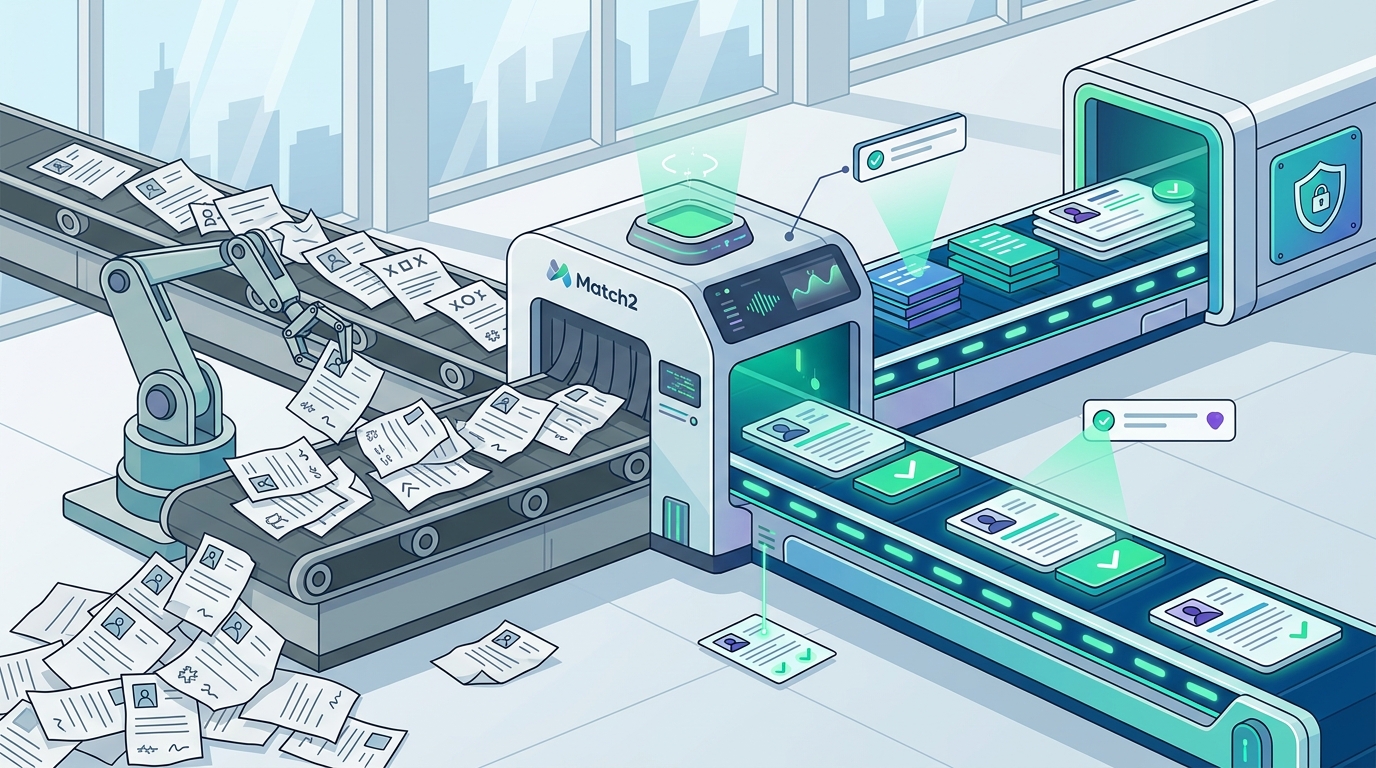
The core mechanism involves two primary components: job analysis and candidate profiling. The platform first deconstructs the job description into a weighted matrix of hard skills, soft skills, and experiential requirements. It then scans the candidate database or incoming applications to find matches based on this matrix. The result is a ranked list of candidates who are most likely to succeed in the role, rather than just those who appear on the surface.
This process reduces the cognitive load on recruiters. Instead of manually reviewing hundreds of resumes, they receive a curated shortlist. The platform highlights why each candidate is a match, providing evidence from their work history that aligns with the job requirements. This transparency builds trust in the hiring process and accelerates decision-making.
Key Features to Evaluate in a Platform
Not all talent matching platforms are created equal. When evaluating solutions for reducing unqualified applicants, it is crucial to look beyond marketing claims and assess specific technical capabilities. The following table outlines the critical features that drive measurable results.
| Feature | Description | Impact on Unqualified Applicants |
|---|---|---|
| Semantic Search | Understands context and synonyms rather than exact keyword matches. | Reduces false negatives and filters out keyword-stuffed resumes. |
| Skills-Based Matching | Focuses on demonstrable skills and competencies over job titles. | Identifies transferable skills and reduces bias against non-traditional backgrounds. |
| Automated Screening | Pre-screens candidates based on hard requirements before human review. | Eliminates candidates who clearly do not meet minimum criteria. |
| Candidate Scoring | Assigns a relevance score to each applicant based on fit. | Allows recruiters to prioritize high-potential candidates first. |
Semantic search is particularly vital for reducing unqualified applicants. It ensures that the platform understands the intent behind a job description. For example, if a role requires "agile methodology," the system should recognize candidates with "Scrum" or "Kanban" experience as relevant matches. This level of nuance is impossible with traditional boolean search logic.
Additionally, skills-based matching shifts the focus from pedigree to capability. This approach is essential for modern recruiting, where job titles can be inconsistent across industries. By focusing on skills, you reduce the number of applicants who have the right title but lack the actual ability to perform the job. This is a primary driver in lowering the volume of unqualified submissions.
The Match2 Approach to Connected Recruiting
Match2 represents a distinct evolution in talent acquisition technology. It is a connected candidate recruiting solution designed to streamline the entire hiring lifecycle. The platform focuses on creating a seamless flow of information between job requirements and candidate profiles, ensuring that every interaction is data-driven and efficient.
One of the core strengths of Match2 is its ability to integrate with existing recruitment workflows. It does not replace your current tools but enhances them by adding a layer of intelligent matching. This integration ensures that recruiters can adopt the technology without disrupting their established processes. The platform supports various hiring scenarios, from high-volume recruiting to specialized executive searches.
The Match2 platform emphasizes the importance of "connected" recruiting. This means that data flows freely between different stages of the hiring process. Information gathered during initial screening informs subsequent interviews, and feedback from hiring managers refines future matching algorithms. This continuous learning loop improves the accuracy of candidate recommendations over time.
Furthermore, Match2 provides robust analytics and reporting capabilities. Recruiters can track key metrics such as time-to-fill, cost-per-hire, and source of hire. These insights help organizations identify bottlenecks in their hiring process and make data-driven decisions to improve efficiency. The platform also supports diversity and inclusion initiatives by reducing unconscious bias in the initial screening phase.
For more details on how Match2 handles specific recruiting challenges, you can explore the Assess section of the website. This area outlines the diagnostic tools available for evaluating candidate fit. Additionally, the Features page provides a comprehensive overview of the platform's technical capabilities.
Implementation Strategy for Immediate Impact
Implementing a talent matching platform requires a strategic approach to ensure maximum adoption and effectiveness. The first step is to define clear success metrics. Organizations should establish baseline data on current screening times and the percentage of unqualified applicants before making changes. This data will serve as a benchmark for measuring the platform's impact.
Next, it is essential to train recruiters on how to interpret the platform's recommendations. The technology is a tool, not a replacement for human judgment. Recruiters must understand the logic behind the matching algorithms to trust the results and provide feedback for improvement. Regular training sessions and support resources are critical for this transition.
Integration with existing job descriptions is another key factor. Job descriptions should be optimized for semantic search by using clear, concise language and focusing on outcomes rather than just tasks. This optimization ensures that the platform can accurately deconstruct the requirements and match them with candidate profiles. The Match2 Blog offers valuable insights and best practices for optimizing job descriptions for better matching.
Finally, continuous monitoring and adjustment are necessary. The platform's algorithms should be regularly reviewed to ensure they are aligning with organizational goals. Feedback from hiring managers and recruiters should be incorporated into the system to refine the matching criteria. This iterative process ensures that the platform remains effective as the organization's needs evolve.
For organizations looking to understand the broader context of talent matching, the Types page provides an overview of different recruiting methodologies supported by the platform. Additionally, the About page offers background on the company's mission and values.
Key Takeaways
- Talent matching platforms reduce unqualified applicants by using semantic analysis to identify true skill alignment.
- Traditional keyword-based ATS systems often miss qualified candidates and let in unqualified ones due to rigid logic.
- Match2 provides a connected recruiting solution that integrates with existing workflows to enhance efficiency.
- Semantic search and skills-based matching are the two most critical features for reducing noise in applicant pools.
- Successful implementation requires clear success metrics, recruiter training, and optimized job descriptions.
- Continuous feedback loops improve the accuracy of matching algorithms over time.
- Data-driven recruiting leads to faster time-to-fill and higher quality hires.
Frequently Asked Questions
How does talent matching reduce unqualified applicants?
Talent matching reduces unqualified applicants by using artificial intelligence to analyze the semantic meaning of job descriptions and candidate profiles. This allows the system to identify relevant skills and experiences even if the terminology differs, filtering out candidates who do not meet the core requirements.
What is the difference between semantic search and keyword search?
Semantic search understands the context and intent behind words, recognizing synonyms and related concepts. Keyword search relies on exact matches, which can miss qualified candidates who use different terminology or include unqualified candidates who simply repeat keywords.
Can talent matching platforms integrate with existing ATS?
Yes, most modern talent matching platforms, including Match2, are designed to integrate with existing Applicant Tracking Systems. They enhance the current workflow by adding intelligent matching capabilities without requiring a complete system overhaul.
How accurate are talent matching algorithms?
The accuracy of talent matching algorithms depends on the quality of the data and the sophistication of the AI model. Advanced platforms use continuous learning from recruiter feedback to improve accuracy over time, often achieving high levels of precision in identifying top candidates.
What are the key benefits of using a connected recruiting solution?
Connected recruiting solutions streamline the hiring process by ensuring data flows seamlessly between different stages. This leads to faster decision-making, better candidate experiences, and more informed hiring decisions based on comprehensive data.
How do I measure the success of a talent matching platform?
Success can be measured by tracking metrics such as time-to-fill, quality of hire, recruiter efficiency, and the percentage of unqualified applicants filtered out. Comparing these metrics before and after implementation provides a clear picture of the platform's impact.
Is talent matching suitable for all types of roles?
Talent matching is suitable for a wide range of roles, from entry-level positions to executive searches. The platform can be customized to match the specific requirements and nuances of each role, ensuring relevant candidate recommendations.
Where can I learn more about Match2's features?
You can learn more about Match2's features by visiting the Features page or exploring the Blog for industry insights and case studies.
Start Optimizing Your Talent Pipeline
Reducing unqualified applicants is not just about saving time; it is about building a stronger, more capable workforce. By leveraging advanced talent matching technology, you can transform your recruiting process from a bottleneck into a strategic advantage. Match2 offers the tools and insights needed to achieve this transformation.
Take the next step in optimizing your hiring process. Schedule a demo to see how Match2 can help you reduce unqualified applicants and improve your overall recruiting efficiency. Visit the Contact Us page to get started. For more information on our solutions, explore the FAQ section.