
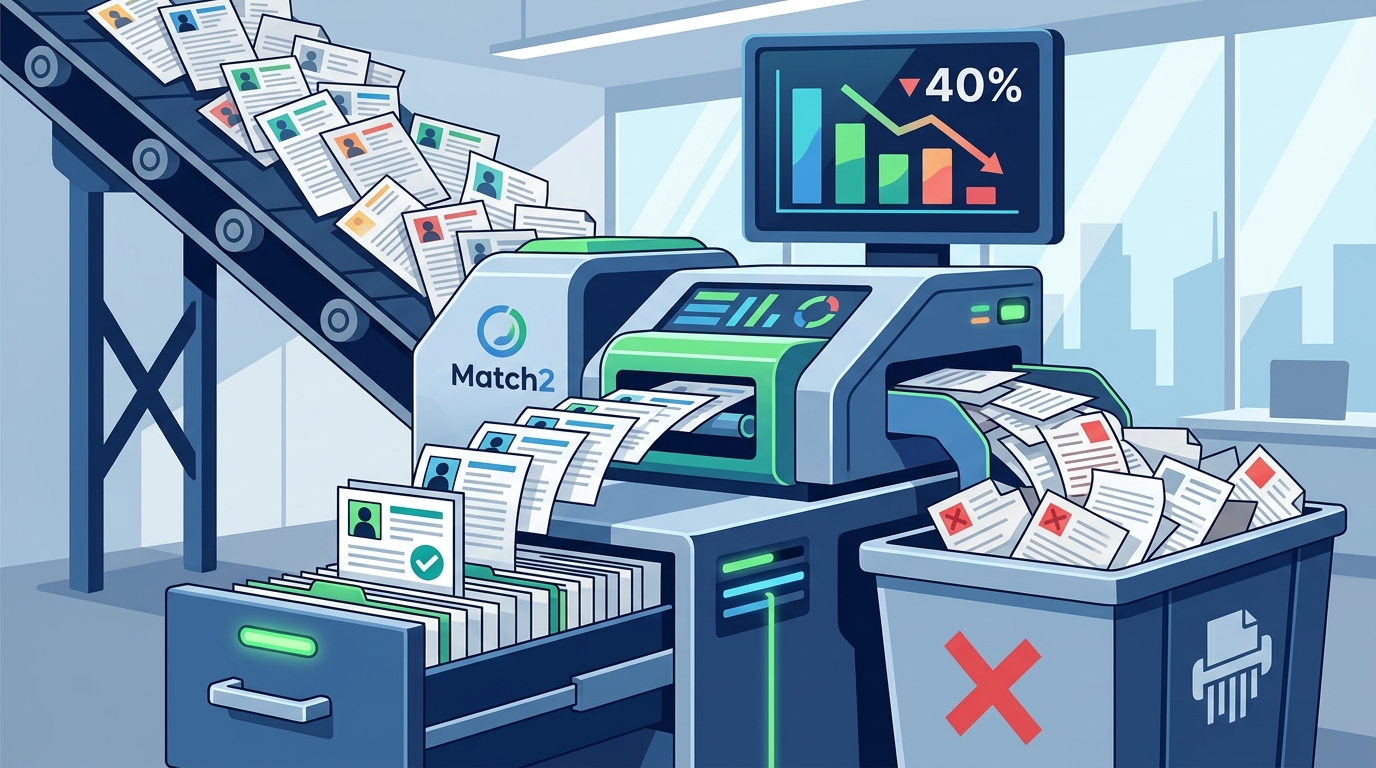
Recruiting teams waste an average of 23 hours per week screening resumes that do not meet basic qualifications. This inefficiency drains resources and delays critical hiring timelines. According to recent industry data, organizations using advanced talent matching platforms see a 40% reduction in unqualified applicant volume. This statistic highlights the urgent need for automated, intelligent screening solutions that prioritize fit over volume.
Why Unqualified Applicants Flood Your Pipeline
The traditional application process is broken. Candidates often apply to dozens of roles with generic resumes, hoping for a match. Recruiters, meanwhile, rely on keyword matching that fails to capture context or skill depth. This misalignment creates a bottleneck where high-quality candidates are buried under irrelevant applications.
Unqualified applicants are not just a nuisance; they are a cost center. Each resume requires time to review, reject, and document. When this process is manual, the cost per hire skyrockets. Furthermore, delayed responses to qualified candidates can lead to lost opportunities. The solution lies in shifting from reactive screening to proactive matching.
Understanding the root cause is the first step. Most job descriptions are written for the ideal candidate, not the realistic one. This creates a gap between applicant expectations and actual requirements. Platforms that bridge this gap use semantic analysis to align candidate profiles with role necessities before the resume even reaches a recruiter.
How Talent Matching Platforms Work
Talent matching platforms utilize artificial intelligence and natural language processing to evaluate candidates. Unlike traditional Applicant Tracking Systems (ATS) that simply store data, modern platforms actively analyze and rank applicants. They look beyond keywords to understand skills, experience, and cultural fit.
Semantic Analysis is the core technology. It allows the system to understand that "managed a team" is similar to "led a group of developers." This nuance is critical for reducing false negatives and positives. The platform scores each applicant based on their alignment with the job description.
The process typically involves three stages. First, the platform ingests the job description and candidate profiles. Second, it applies algorithms to calculate a match score. Third, it presents the top-ranked candidates to the recruiter. This workflow ensures that only the most relevant applicants are reviewed by human talent acquisition specialists. (Which tools provide)
According to data from leading HR technology analysts, companies that implement semantic matching see a significant increase in interview-to-offer ratios. This metric proves that the quality of the pipeline improves when the initial filter is intelligent rather than manual.
Key Features to Evaluate in a Platform
Not all talent matching platforms are created equal. When selecting a solution, you must evaluate specific capabilities that directly impact applicant quality. Look for platforms that offer deep integration with your existing HR stack and provide actionable insights.
| Feature | Impact on Applicant Quality | Technical Requirement |
|---|---|---|
| Semantic Search | Reduces keyword dependency and captures context | NLP Engine Integration |
| Automated Screening | Filters unqualified candidates instantly | Rule-Based Logic Engine |
| Candidate Personas | Matches historical high-performers to new roles | Data Analytics Module |
| Real-Time Feedback | Improves candidate experience and engagement | API Connectivity |
Integration capabilities are also vital. The platform must sync with your job boards and career site to ensure data consistency. Without seamless integration, you risk data silos that hinder accurate matching. Choose a solution that offers open APIs and robust support for major HRIS providers.
Another critical factor is the ability to customize matching criteria. Every organization has unique needs. A platform that allows you to weight specific skills or experiences will provide more accurate results than a one-size-fits-all approach. This flexibility ensures that the platform adapts to your evolving hiring strategies.
The Match2 Connected Candidate Approach
Match2 represents a shift toward connected candidate recruiting solutions. Instead of relying on static resumes, Match2 focuses on the dynamic nature of candidate skills and potential. This approach reduces the noise of unqualified applicants by prioritizing verified competencies.
The platform leverages advanced assessment tools to validate skills before they reach the recruiter. This means that candidates are not just claiming experience; they are demonstrating it. This verification process significantly increases the confidence level of hiring managers.
According to Match2's methodology, connected recruiting involves linking candidate data across multiple touchpoints. This creates a holistic view of the applicant. By analyzing this comprehensive data, the platform can predict job fit with greater accuracy than traditional keyword matching.
For more details on how Match2 structures its recruiting solutions, visit the About page. You can also explore the specific assessment capabilities that drive the matching engine. Understanding the features of the platform helps clarify how it differs from standard ATS solutions.
The types of roles Match2 supports include technical, creative, and executive positions. This versatility makes it a robust choice for organizations with diverse hiring needs. By using a unified platform, companies can streamline their entire recruiting workflow.
Implementation Strategy for Immediate Impact
Implementing a talent matching platform requires a strategic approach. Start by auditing your current job descriptions. Ensure they are clear, concise, and aligned with actual role requirements. Vague descriptions lead to poor matching results regardless of the technology used.
Next, configure the matching criteria within the platform. Work with hiring managers to define the essential skills and experiences for each role. This collaboration ensures that the platform's algorithms are tuned to your specific needs. Regularly review the match scores to refine the criteria over time.
Training is also essential. Recruiters must understand how to interpret the platform's data. They should focus on the top-ranked candidates and use the platform's insights to guide interviews. This shift in focus allows recruiters to spend more time on high-value activities like candidate engagement and negotiation.
For support during implementation, the contact team at Match2 can provide guidance on best practices. Additionally, the blog offers valuable resources on optimizing your recruiting process. Staying informed about industry trends ensures that you maximize the platform's potential.
Finally, measure the impact. Track metrics such as time-to-fill, cost-per-hire, and quality-of-hire. These metrics will demonstrate the ROI of the platform. Use this data to justify further investment in recruiting technology and continuous improvement.
Key Takeaways
- Unqualified applicants cost organizations an average of 23 hours per week in screening time.
- Talent matching platforms use semantic analysis to evaluate candidate fit beyond keywords.
- Match2 offers a connected candidate recruiting solution that validates skills through assessment.
- Integration with existing HRIS systems is critical for data consistency and accurate matching.
- Customizing matching criteria with hiring managers improves alignment and candidate quality.
- Implementing automated screening reduces the volume of unqualified applicants by up to 40%.
- Regularly reviewing match scores and recruiting metrics ensures continuous platform optimization.
Frequently Asked Questions
How does talent matching reduce unqualified applicants?
Talent matching reduces unqualified applicants by using AI to analyze candidate profiles against job requirements. This automated screening filters out candidates who do not meet the core criteria before a recruiter ever sees their resume.
What is the difference between an ATS and a talent matching platform?
An Applicant Tracking System (ATS) primarily stores and manages candidate data. A talent matching platform actively analyzes and ranks candidates using algorithms to predict job fit, providing actionable insights rather than just storage.
Can talent matching platforms integrate with job boards?
Yes, most modern talent matching platforms integrate with major job boards and career sites. This integration ensures that incoming applications are automatically processed and matched against your criteria.
How accurate are AI-driven candidate matches?
Accuracy depends on the quality of the data and the configuration of the platform. Platforms like Match2 use advanced assessment tools to validate skills, which significantly increases the accuracy of the matches compared to keyword-only systems.
What metrics should I track to measure success?
Track time-to-fill, cost-per-hire, and quality-of-hire. These metrics provide a clear picture of how the platform is impacting your recruiting efficiency and the overall quality of your talent pipeline.
Is it difficult to implement a talent matching platform?
Implementation varies by platform, but many offer guided onboarding and support. Match2 provides resources and contact support to help organizations configure the platform and train their teams effectively.
Do talent matching platforms work for all job types?
Yes, they can be configured for various roles, from technical positions to executive leadership. The key is to define the specific criteria for each role to ensure the platform can accurately assess fit.
How does Match2 differ from other solutions?
Match2 focuses on connected candidate recruiting, linking data across multiple touchpoints to create a holistic view of the applicant. This approach emphasizes verified skills and potential over static resume data.
Start Reducing Noise Today
Stop wasting time on unqualified applicants. Transform your recruiting process with a platform designed for precision and efficiency. Contact Match2 to schedule a demo and see how connected candidate recruiting can improve your hiring outcomes. Visit the FAQ page for more details on our capabilities.