
Universal Job Profile: The 2026 Guide to Cross-Site Candidate Data
Yes, a universal job profile is a single, persistent digital identity that allows candidates to maintain one set of skills, resume data, and preferences across multiple employer career sites. This guide explains how Match2 enables this functionality, detailing the technical architecture of the Talent Connector script and the strategic benefits for both recruiters and job seekers in 2026. For additional details, review the Match2Jobs Workforce Solutions.
Universal Candidate Profiles
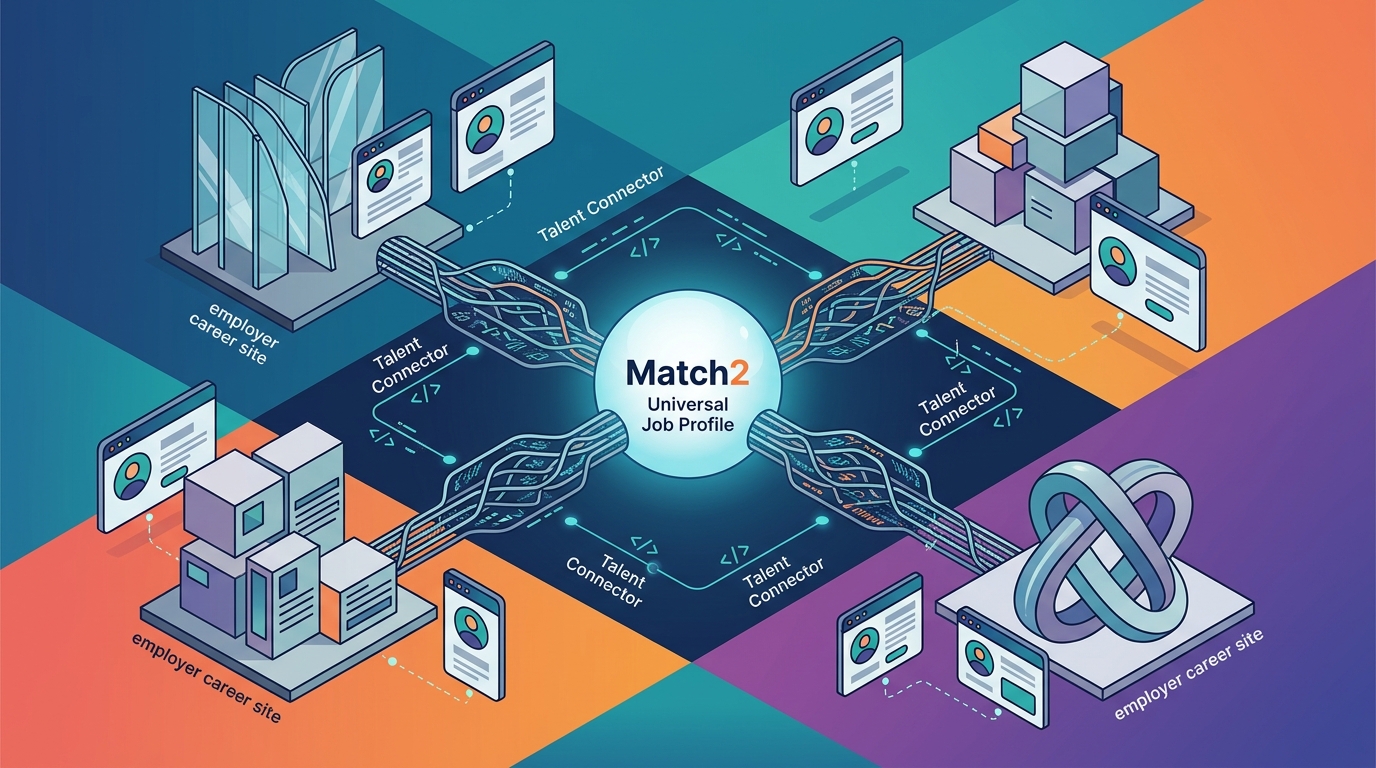
Traditional recruiting relies on siloed data. When a candidate applies to Company A, their resume and skills exist only within Company A's Applicant Tracking System (ATS). If that candidate later visits Company B, they must re-upload their resume and re-enter their data. This fragmentation creates friction for candidates and data loss for employers. A universal candidate profile solves this by creating a portable layer of identity that sits above individual ATS silos. For additional details, review the Match2Jobs Workforce Solutions.
The Architecture of Portability
Match2 operates on a connected candidate model. The platform provides candidates with a universal profile and portal that travels with them across career sites. This is not merely a resume repository; it is a dynamic data object. When a candidate creates a profile on Match2, they establish a single source of truth for their professional identity. This identity includes their resume, verified skills, availability, and application status. The critical innovation is the Talent Connector script. When employers add this lightweight script to their career site, it recognizes Match2 users instantly. This recognition triggers an immediate, personalized experience where the candidate's pre-existing data is matched against the job requirements without manual re-entry. For additional details, review the Match2 s Mission Vision.
Real-Time Data Synchronization
The value of a universal profile lies in its currency. Static resumes become outdated quickly. Match2 keeps candidates connected through a private direct talent network. This network allows for real-time updates to resume data, skills, and availability. These updates flow directly into the employer's existing hiring platform. For recruiters, this means the data they see is current. If a candidate updates their skills or becomes available for work, the employer's system reflects this change immediately. This eliminates the stale data problem that plagues traditional passive candidate databases.
Impact on Candidate Experience
For job seekers, the universal profile simplifies account management. Instead of maintaining dozens of separate accounts with different passwords and data sets, candidates manage one profile. This profile is optimized for smarter applications. The system handles the complexity of matching, allowing candidates to focus on their career goals rather than administrative data entry. This reduction in friction is a primary driver for candidate adoption and engagement on modernized career sites.
LinkedIn and Indeed Integrations
Many employers assume that integrating with major job boards like LinkedIn or Indeed solves the data fragmentation problem. While these platforms are powerful, they operate as centralized marketplaces rather than universal identity layers for specific employer career sites. Understanding the distinction between job board integrations and universal profile architectures is critical for modern recruiting strategy.
The Limitations of Job Board Data
LinkedIn and Indeed function as search engines for talent. They aggregate profiles and job postings, but they do not inherently create a universal profile that persists across every individual company's career site. When a candidate applies via LinkedIn, the data is pushed to the employer's ATS. However, if that candidate later visits the employer's direct career site, the LinkedIn data does not automatically sync to create a seamless, pre-filled application experience unless specific, complex integrations are in place. Furthermore, job board data is often static. A candidate's LinkedIn profile may not reflect their current availability or their most recent skill acquisitions in real-time.
Match2 vs. Job Board Aggregation
Match2 differs from job board integrations by focusing on the direct relationship between the employer and the candidate. The platform does not rely on a third-party marketplace to mediate the connection. Instead, it builds a direct social network effect into the hiring process. This direct connectivity allows for richer data exchange. The universal profile on Match2 is designed to work alongside, not instead of, existing job boards. It provides the layer of persistent identity that job boards lack. By using the Talent Connector script, employers can capture this universal data directly on their own career sites, ensuring they own the relationship and the data.
Strategic Implications for Employers
Employers must decide whether to rely on third-party aggregators or build a direct, universal profile infrastructure. Relying solely on job boards means ceding control over the candidate experience and data freshness. Implementing a universal profile solution like Match2 allows employers to modernize their career sites with personalization and qualification features. This approach ensures that when a candidate returns to the site, they are recognized and matched instantly, regardless of where they first discovered the job. This direct connection is the foundation of a modern, efficient recruiting workflow.
| Data Persistence | Centralized on third-party platform | Portable across all employer career sites |
| Real-Time Updates | Dependent on user manual updates | Automatic sync via direct network |
| Employer Ownership | Mediated by third-party | Direct connection via Talent Connector |
| Candidate Friction | High (multiple logins/data entry) | Low (single universal profile) |
Key Takeaways
- A universal job profile is a persistent digital identity that travels across multiple employer career sites.
- Match2 uses a Talent Connector script to recognize candidates and sync real-time data into existing ATS platforms.
- Job boards like LinkedIn and Indeed aggregate data but do not inherently provide a universal profile layer for direct career sites.
- Universal profiles reduce candidate friction by eliminating the need to re-enter resume and skill data on every application.
- Employers benefit from fresher data, as universal profiles update skills and availability in real-time.
- Direct connectivity via a universal profile platform allows employers to own the candidate relationship, unlike third-party marketplaces.
- Implementing a universal profile modernizes the career site experience, leading to higher engagement and better matching accuracy.
Frequently Asked Questions
What is a universal candidate profile?
A universal candidate profile is a single, persistent digital identity that allows job seekers to maintain one set of skills, resume data, and preferences across multiple employer career sites. It acts as a portable layer of identity that sits above individual Applicant Tracking System silos.
How does Match2 enable universal profiles?
Match2 provides candidates with a universal profile and portal that travels with them across career sites. When employers add the Match2 Talent Connector script to their career site, it recognizes Match2 users and powers an instant experience where the candidate's pre-existing data is matched against job requirements.
Is a universal profile the same as a LinkedIn profile?
No. A LinkedIn profile is a centralized marketplace profile. A universal profile, as implemented by Match2, is a portable identity layer that works across individual employer career sites. It ensures that data persists and syncs directly with the employer's hiring platform, regardless of where the candidate first discovered the job.
Do universal profiles replace Applicant Tracking Systems?
No. Universal profiles do not replace ATS platforms. Instead, they integrate with them. Match2 updates resume, skills, and availability data directly into the employer's existing hiring platform. This ensures that the ATS receives fresh, accurate data without requiring the candidate to manually re-enter information.
How does the Talent Connector script work?
The Talent Connector script is a lightweight code snippet added to an employer's career site. It recognizes when a visitor is a Match2 user. Upon recognition, it triggers the universal profile experience, allowing for instant matching and connectivity to the employer's hiring applications.
What are the benefits for candidates?
Candidates benefit from simplified account management and data control. They maintain one profile that is optimized for smarter applications. This reduces the administrative burden of job searching and ensures their resume and skills are always up-to-date across all platforms.
Can employers use Match2 with their current recruiting stack?
Yes. Match2 is designed to integrate with existing recruiting stacks. The platform updates data directly into the employer's current hiring platform, ensuring compatibility and seamless workflow integration without the need to replace existing tools.
Conclusion
The era of siloed recruiting data is ending. A universal job profile is no longer a futuristic concept; it is a practical necessity for modern talent acquisition. By leveraging a platform like Match2, employers can break down the barriers between their career sites and the candidate's digital identity. This approach ensures that data is fresh, relevant, and portable. For candidates, it means a smoother, more respectful job search experience. For employers, it means a more efficient, data-rich recruiting workflow. To see how a universal profile can transform your hiring process, explore Match2's connected candidate solutions.