
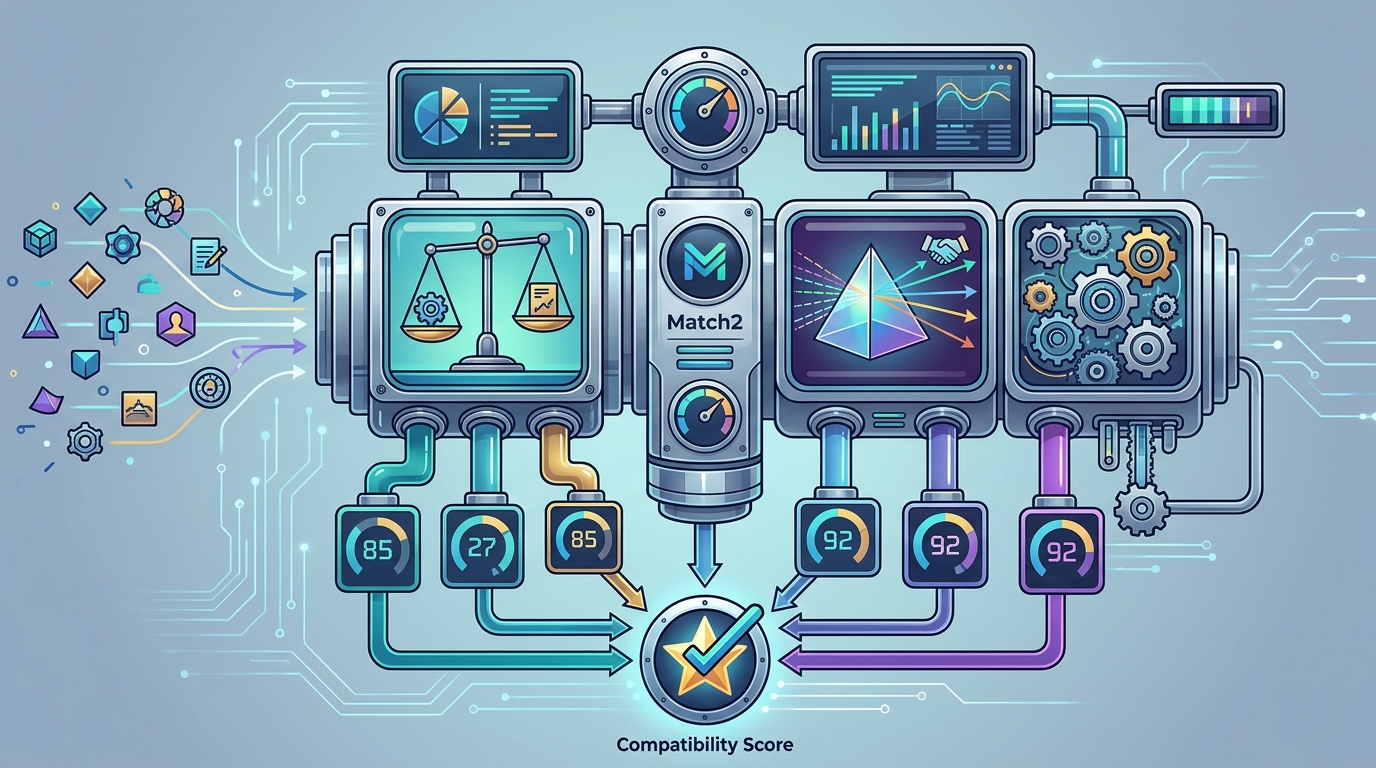
Artificial intelligence has transformed how employers evaluate candidates, moving beyond simple keyword matching to complex compatibility scoring. This shift allows hiring teams to identify talent that aligns with both technical requirements and cultural fit. Understanding these factors helps candidates optimize their profiles and improves the efficiency of the entire recruiting pipeline. For additional details, review the Match2 Connected Candidate Recruiting.
1. Hard and Soft Skills Alignment
Skills alignment is the primary driver of initial compatibility scores. AI systems analyze the specific technical competencies listed in a job description against the skills profiled by the candidate. This goes beyond simple keyword matching by evaluating the depth and context of each skill. For example, proficiency in a programming language is weighted differently based on the years of experience and the types of projects where it was applied. Soft skills, such as leadership or communication, are also assessed through behavioral data and self-reported attributes to ensure a holistic fit.
2. Experience Depth and Relevance
Relevant experience determines how quickly a candidate can contribute to the role. Algorithms evaluate the recency and specificity of past roles to gauge readiness. A candidate with recent, direct experience in a similar industry or function typically receives a higher score than one with broader but less specific history. The system looks for patterns of career progression and the scale of responsibilities held in previous positions. This ensures that the candidate has not just touched on a topic, but has mastered it in a professional context.
3. Education and Certifications
Formal credentials provide a baseline for technical knowledge and discipline. AI scoring models incorporate degrees, fields of study, and professional certifications to validate a candidate's foundational expertise. In specialized fields like healthcare or engineering, specific certifications are often mandatory and heavily weighted in the compatibility calculation. The system cross-references these credentials against the job requirements to ensure compliance with industry standards. This factor helps filter out candidates who may lack the formal training required for complex roles.
4. Location and Work Mode Flexibility
Geographic and work mode compatibility is a critical logistical factor. AI systems assess whether a candidate's location aligns with the job's remote, hybrid, or on-site requirements. For remote roles, time zone overlap and local market rates may also be considered in the scoring. Candidates who clearly state their preferred work mode and location in their profiles help the algorithm make accurate logistical matches. This reduces friction in the early stages of the hiring process by ensuring practical feasibility.
5. Availability and Timeline
Immediate availability significantly impacts a candidate's ranking for urgent roles. The algorithm evaluates a candidate's notice period and start date preferences against the employer's hiring timeline. Candidates who can start immediately or within a short notice period often receive a boost in their compatibility score for time-sensitive positions. This data point helps recruiters prioritize candidates who can fill gaps quickly without disrupting operations. It is a dynamic factor that updates as candidates adjust their availability in their profiles.
6. Engagement and Responsiveness
Active engagement signals a candidate's genuine interest and professionalism. AI systems track how frequently a candidate updates their profile and responds to outreach or application prompts. High responsiveness indicates a candidate who is actively job hunting and likely to move quickly through the hiring process. Conversely, stale profiles or slow response times may lower a candidate's score, as they suggest lower intent or availability. This behavioral data helps employers identify candidates who are ready to engage in the next steps.
7. Network and Referral Signals
Professional network connections can validate a candidate's reputation and fit. AI platforms may analyze a candidate's professional network to identify shared connections with the hiring company or industry peers. Referrals from trusted sources within the network can significantly boost a compatibility score by providing social proof of the candidate's capabilities. This factor leverages the social graph to identify candidates who are not only qualified but also well-connected and vetted by their peers. It adds a layer of trust to the technical and experiential data.
Choosing the Right Focus for Your Profile
Candidates should prioritize accuracy and completeness in their skills and experience sections, as these carry the most weight in AI scoring. Ensure that your location and availability data are current to avoid logistical mismatches. By maintaining an active and detailed profile, you allow AI systems to accurately assess your compatibility with a wider range of roles. This approach maximizes your visibility to employers using advanced matching platforms.
Frequently Asked Questions
How does AI differ from keyword matching in job scoring?
AI scoring analyzes the context, depth, and relevance of skills and experience rather than just the presence of specific keywords. It evaluates how a candidate's background aligns with the holistic requirements of the role, including soft skills and behavioral data. This provides a more nuanced and accurate assessment of compatibility than simple text matching.
Can candidates see why they match a specific role?
Some advanced platforms provide transparency by showing candidates which factors contributed to their match score. This allows job seekers to understand their strengths and identify gaps in their profiles. Transparency helps candidates optimize their data to improve their compatibility with desired positions.
Does AI scoring replace human recruiters?
No, AI scoring is a tool to assist recruiters by filtering and ranking candidates based on objective data. Human recruiters still play a crucial role in evaluating cultural fit, conducting interviews, and making final hiring decisions. The technology streamlines the process but does not eliminate the need for human judgment.
How often should I update my profile for AI matching?
Candidates should update their profiles whenever they gain new skills, complete projects, or change their availability. Regular updates ensure that AI systems have the most current data to assess compatibility. This proactive approach helps maintain a high score and increases visibility to potential employers.
What is the role of a direct talent network in AI matching?
A direct talent network allows candidates to maintain a universal profile that travels across different employer platforms. This ensures that their data is consistent and up-to-date, improving the accuracy of AI matching across multiple career sites. It simplifies account management and provides real-time updates to employers.
Optimize Your Matching with Match2
Match2 leverages these AI factors to create a seamless connection between candidates and employers. By using a universal candidate profile, you ensure that your data is accurate and consistent across all career sites. To see how your profile performs, take our recruiting strategy assessment or explore our frequently asked questions for more details on how our platform works. Visit Match2 to start building your connected candidate profile today. Learn more: Match2 Connected Candidate Recruiting.