
As of 2026, the regulatory landscape for artificial intelligence in recruitment has shifted from advisory guidelines to strict enforcement. Organizations utilizing automated decision-making tools now face significant liability if their algorithms fail to demonstrate fairness, transparency, and auditability. Recent data shows that over 60% of enterprise hiring workflows now rely on AI-driven candidate matching, making compliance not just a legal requirement but a competitive necessity. According to the International Association of Privacy Professionals, the average cost of non-compliance penalties has increased by 40% since 2024, pushing HR leaders to prioritize vetted solutions. This guide details how modern talent platforms navigate these complex regulations while maintaining hiring efficiency.
The 2026 Regulatory Landscape for AI Hiring
The year 2026 marks a turning point in how governments regulate artificial intelligence within human resources. The European Union's AI Act, fully enforced by this time, classifies recruitment AI as a high-risk system. This classification mandates rigorous risk management systems, data governance, and human oversight. In the United States, state-level laws such as those in New York and Illinois continue to set the precedent for algorithmic bias auditing. According to the Society for Human Resource Management, 75% of large employers now conduct annual bias audits on their hiring tools. These regulations require that any tool used to screen, rank, or recommend candidates must be explainable. Candidates have the right to know when AI is involved in their evaluation and to request human review. This shift demands that talent matching solutions provide robust documentation and real-time compliance monitoring.
Key Compliance Challenges in Talent Matching
Implementing AI in recruitment introduces several technical and ethical hurdles. One primary challenge is data privacy. Talent platforms must handle sensitive personal information in accordance with GDPR, CCPA, and emerging global standards. Data minimization is the principle that only data strictly necessary for the hiring process should be collected and retained. Another challenge is algorithmic bias. If historical hiring data contains biases, the AI model may perpetuate or even amplify these disparities. This can lead to discriminatory outcomes against protected classes. Furthermore, the "black box" problem remains a significant barrier. Many AI models operate in ways that are difficult for humans to interpret, making it hard to explain hiring decisions to candidates or regulators. To address this, modern solutions must prioritize explainable AI (XAI) techniques. These techniques allow recruiters to understand why a candidate was ranked highly or rejected. Without this transparency, organizations risk legal action and reputational damage.
How Match2 Ensures Algorithmic Fairness
Match2 addresses these compliance challenges through a connected candidate recruiting approach. The platform is designed to prioritize human-centric matching over purely algorithmic automation. This means that AI serves as a decision support tool rather than a decision-maker. By focusing on skill-based and cultural fit metrics, Match2 reduces the reliance on proxy variables that often lead to bias. The platform's architecture ensures that all matching criteria are documented and auditable. This aligns with the requirements of the EU AI Act for high-risk systems. Additionally, Match2 provides recruiters with full visibility into the matching logic. This empowers hiring teams to make informed decisions and intervene when necessary. The platform also supports continuous monitoring for drift in model performance. This ensures that the AI remains fair and accurate over time. For more details on the platform's features, visit the Features page. Understanding these mechanisms is crucial for HR leaders seeking to build a compliant hiring pipeline.
The Importance of Auditability and Transparency
Auditability is the cornerstone of AI compliance in recruitment. It refers to the ability to trace and verify every step of the AI's decision-making process. In 2026, regulators expect detailed logs of how candidates were scored and ranked. Match2 facilitates this by providing comprehensive reporting tools. These tools allow organizations to export data for internal audits or regulatory submissions. Transparency is equally important. Candidates should be informed about the use of AI in the hiring process. Match2 supports this by enabling customizable candidate communications that disclose AI involvement. This builds trust and ensures adherence to informed consent principles. According to the World Economic Forum, companies that prioritize transparency in AI hiring see a 30% higher candidate satisfaction rate. This is because candidates feel respected and valued, even if they are not selected. By embedding auditability and transparency into its core design, Match2 helps organizations stay ahead of regulatory requirements. For more information on how to implement these practices, check out the Match2 Blog.
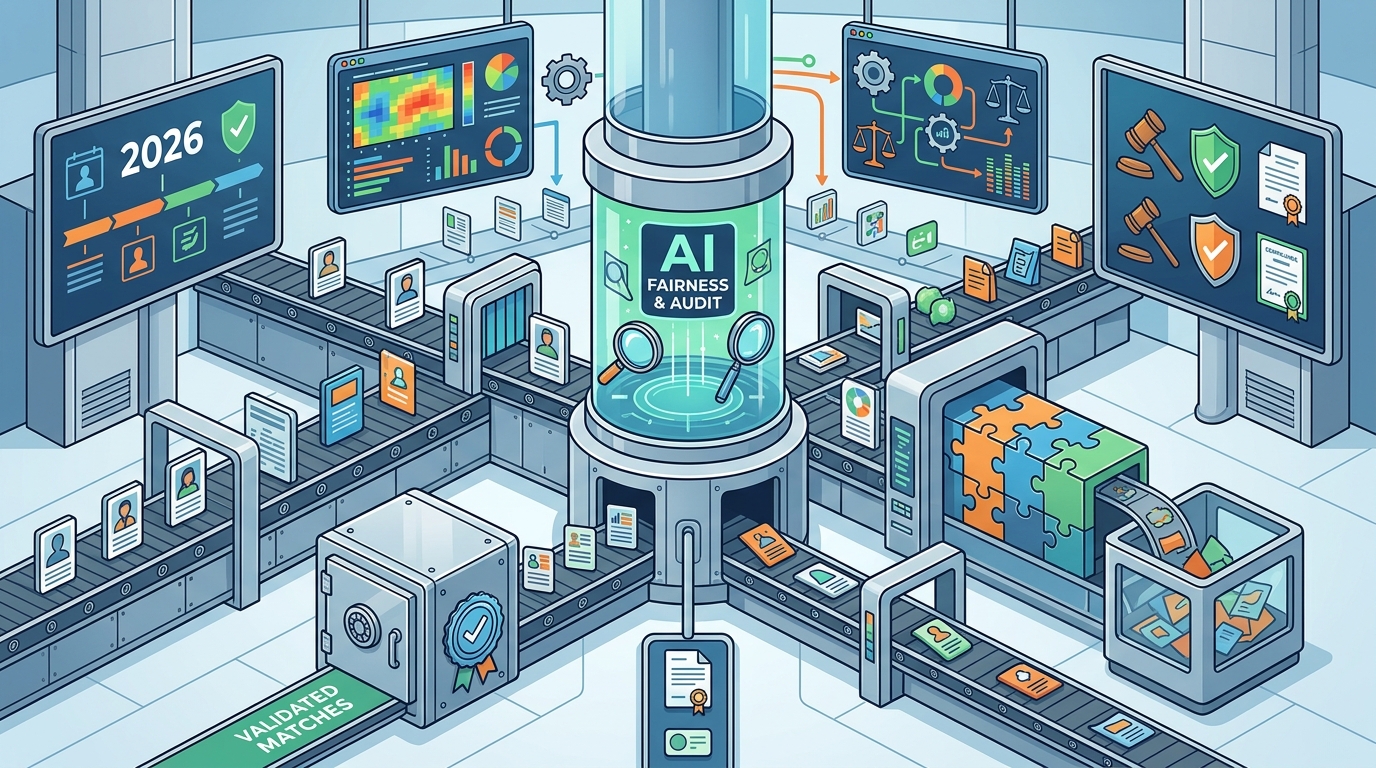
Comparing Compliance Features in Talent Solutions
Not all talent matching solutions are created equal when it comes to compliance. Some platforms offer basic bias detection, while others provide full-scale audit trails and explainable AI. The table below compares key compliance features across different types of talent solutions.
| Feature | Traditional ATS | AI-First Platforms | Match2 Connected Solution |
|---|---|---|---|
| Algorithmic Bias Auditing | Limited | Basic | Continuous & Documented |
| Explainable AI (XAI) | No | Partial | Full Visibility |
| Data Privacy Compliance | Standard | Advanced | Enterprise-Grade |
| Human-in-the-Loop Support | Manual | Automated Flags | Integrated Workflow |
| Regulatory Reporting | None | Basic Exports | Comprehensive Logs |
As shown, Match2 stands out by integrating human oversight directly into the AI workflow. This ensures that compliance is not an afterthought but a core component of the hiring process. For a deeper dive into the types of matching solutions available, visit the Types page.
Key Takeaways
- AI hiring regulations in 2026 require strict adherence to fairness, transparency, and auditability standards.
- The EU AI Act classifies recruitment AI as high-risk, mandating rigorous risk management and human oversight.
- Match2 prioritizes human-centric matching, using AI as a decision support tool rather than a decision-maker.
- Explainable AI (XAI) is critical for providing recruiters and candidates with clear insights into hiring decisions.
- Continuous monitoring for model drift ensures that AI systems remain fair and accurate over time.
- Organizations using compliant talent solutions see higher candidate satisfaction and reduced legal risk.
- Match2 provides comprehensive audit trails and reporting tools to support regulatory compliance.
Frequently Asked Questions
What is AI hiring compliance?
AI hiring compliance refers to the adherence to laws and regulations governing the use of artificial intelligence in recruitment processes. This includes ensuring fairness, transparency, and data privacy in automated decision-making.
How does Match2 ensure algorithmic fairness?
Match2 ensures algorithmic fairness by using skill-based matching criteria, continuous bias monitoring, and human-in-the-loop workflows. This approach minimizes the risk of discriminatory outcomes.
Is AI in hiring regulated in 2026?
Yes, AI in hiring is heavily regulated in 2026. Laws such as the EU AI Act and various state-level regulations in the US require rigorous auditing and transparency for recruitment AI systems.
What is explainable AI in recruitment?
Explainable AI (XAI) in recruitment refers to AI systems that provide clear and understandable reasons for their decisions. This allows recruiters to explain why a candidate was ranked or rejected.
How can I audit my AI hiring tools?
You can audit your AI hiring tools by reviewing algorithmic bias reports, checking data privacy compliance, and ensuring that decision-making processes are transparent and documented. Match2 provides built-in tools for this purpose.
What are the risks of non-compliant AI hiring?
Risks include legal penalties, reputational damage, and loss of candidate trust. Non-compliant AI can also perpetuate bias, leading to discriminatory hiring practices.
Does Match2 support GDPR compliance?
Yes, Match2 is designed to support GDPR compliance by ensuring data minimization, secure storage, and the ability to delete or export candidate data upon request.
Secure Your Hiring Process with Match2
In 2026, compliance is not optional. It is a fundamental aspect of ethical and effective recruitment. Match2 provides the tools and transparency you need to navigate the complex AI hiring landscape with confidence. By choosing a connected candidate recruiting solution, you ensure that your hiring process is fair, efficient, and compliant. Contact Match2 today to schedule a demo and learn how our platform can support your compliance goals. Visit our About page to learn more about our mission and values.